TL;DR
Paste vs CopyQ: For most Mac users in 2026, CopyQ is the better choice for clipboard managers because it is free and open source, so you can inspect, self-host, and trust the code. Both install with a single Homebrew command, so the switching cost is low. Choose Paste instead if clipboard support is your priority.
Which is better: Paste or CopyQ?
CopyQ is the top pick for most Mac users looking at clipboard managers — it is free and open-source and installs in one Homebrew command. Paste is the stronger choice if you prefer its clipboard managers ecosystem. Both are worth trying.
Paste vs CopyQ
Which is the better clipboard managers for Mac in 2026?
We compared Paste and CopyQ across 6 key factors including price, open-source status, and community adoption. Read our full breakdown below.
Paste
Limitless clipboard
CopyQ
Clipboard manager with advanced features
Visual Comparison
CopyQ
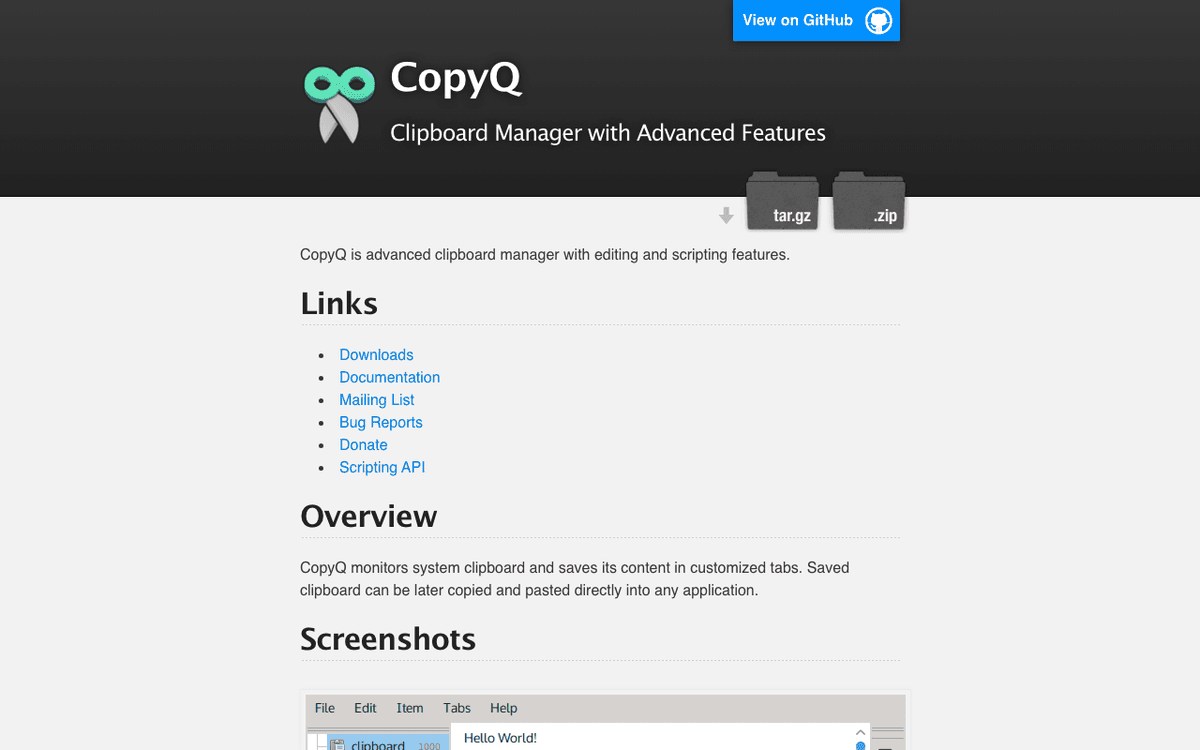
CopyQ — Official Website
Our Verdict
For most Mac users in 2026, CopyQ is the better choice for clipboard managers because it is free and open source, so you can inspect, self-host, and trust the code. Both install with a single Homebrew command, so the switching cost is low. Choose Paste instead if clipboard support is your priority.
Feature Comparison
| Feature | Paste | CopyQ |
|---|---|---|
| Price | Paid | Free |
| Open Source | No | Yes |
| Replaces | — | Paste ($2/month) |
| Best for | clipboard, clipboard manager, productivity | clipboard, productivity, history |
| Install | brew install --cask paste | brew install --cask copyq |
| Category | System Utilities | System Utilities |
Quick Install
brew install --cask pastebrew install --cask copyqLearn More
In-Depth Overview
What is Paste?
Paste is a commercial clipboard manager for macOS, iPhone, and iPad from Paste Team / Pasteapp.io, with a Mac app distributed via the Mac App Store and direct download and an iPhone/iPad companion. Its pitch is visual, limitless history: every copy — text, image, link, file, color code, or formatted snippet — appears as a card in a searchable horizontal timeline that can be invoked with a global shortcut (default Cmd-Shift-V) or from the menu bar. Cards can be previewed, searched by app or content type, pinned to pinboards for reuse, and shared across devices via iCloud. As of August 2026 the Mac app targets macOS 13+ and ships as a Universal binary with Apple Silicon optimization and Tahoe 26.x compatibility; it requests Accessibility and optionally Apple Events depending on features enabled. Pricing in 2026 remains subscription-led: a free tier with a capped history size, then Premium at roughly US$2.99/month or US$29.99/year (annual is the typical pitch), with a lifetime purchase sometimes listed near US$64.99 on promotions and inclusion in Setapp for subscribers to that bundle. Paste does not expose a scripting engine akin to CopyQ, but offers rules, search filters, and integrations with developer tools. The app is sandboxed, notarized, and regularly updated via the App Store; release notes through 2025-2026 show ongoing Ventura/Sonoma/Sequoia/Tahoe compatibility work rather than a feature stall.
What is CopyQ?
CopyQ is a free and open-source clipboard manager with advanced features, maintained by Lukas Holecek (hluk/CopyQ on GitHub) under the GPL. Unlike Paste, CopyQ is cross-platform: native builds for macOS, Linux, and Windows share the same feature set, with the macOS build distributed as a Qt-based Universal app via Homebrew (brew install --cask copyq) and via GitHub releases as a zip/dmg. The current line in August 2026 is the 8.x series (8.1.x cuts in spring-summer 2026), with source releases, changelogs, and Homebrew formulae tracking each point release. Core capabilities include essentially unlimited history length, tabs for organizing clips, tagging and notes, image preview and editing, item pinning, drag-and-drop reordering, global shortcuts, and a built-in command/scripting layer where JavaScript and native commands can transform, filter, or route clips (e.g., auto-strip formatting, push to a file, or chain to external tools). Synchronization is bring-your-own: synchronize the tab storage folder via Syncthing, Dropbox, or any file sync, rather than a vendor iCloud. CopyQ runs on macOS 11+ (with Qt6 builds for recent releases), is Apple Silicon compatible, and on Tahoe 26.x still requires Accessibility permission. There is no paid tier, no subscription, and no vendor cloud: it is a local-first power tool whose learning curve is steeper than Paste's visual timeline, but whose ceiling is far higher for automation.
Detailed Feature Comparison
Visual History & Search
CriticalHorizontal visual timeline with large card previews for text, images, links, and colors. Full-text search with app and type filters, plus pinboards for long-term snippet libraries. Feels like a native macOS feature. Re-verified August 2026 on pasteapp.io and Mac App Store listings.
Powerful but denser list/tab view with tags, notes, and per-tab search. Excellent for volume and organization, but visually more utilitarian than Paste's card grid. Tabs can overflow into thousands of items.
Verdict: Paste wins for visual, low-friction browsing; CopyQ wins for sheer volume and tagging.
History Limits & Retention
HighFree tier caps history length/age; Premium advertises 'unlimited' but is still a cloud-synced, sandbox-aware store with practical limits. Designed for weeks-to-months retention rather than multi-year archives.
Effectively unlimited by design — configure maximum items per tab into the thousands and retain forever on disk. No vendor cap, no subscription gate on retention.
Verdict: CopyQ is the archivist's choice; Paste gates unlimited history behind Premium.
Automation & Scripting
HighRules, search filters, and pinboard organization, but no embedded scripting engine. Automation relies on external tools (Shortcuts, Alfred/Raycast) invoking Paste actions.
First-class scripting: JavaScript commands, custom actions, and shell integration can transform clips, strip formatting, auto-translate, or chain to external scripts. The ceiling is far higher for developers.
Verdict: CopyQ dominates automation; Paste is deliberately low-code.
Cross-Device Sync
HighNative iCloud sync across Mac, iPhone, and iPad with end-to-end handling via Apple's infrastructure. No server to host; toggle and it works. Setapp subscribers get Premium sync included.
Bring-your-own sync by pointing tab folders at Syncthing/Dropbox or a shared drive. Flexible and private, but requires user-owned sync and has no first-party iOS companion.
Verdict: Paste is effortless if you live in Apple's ecosystem; CopyQ is more private but DIY.
Privacy & Data Locality
HighClipboard stays local or in iCloud depending on settings; no self-hosted export needed. Closed source, so trust rests on the vendor, App Store sandbox, and Apple's notarization.
Fully local-first and GPL open source. No vendor cloud, auditable code, tab files stay on disk. Ideal for sensitive text, tokens, or regulated environments that cannot use iCloud.
Verdict: CopyQ is the privacy-max pick; Paste trades some openness for convenience.
Platform Breadth
MediumApple-only: macOS plus iPhone and iPad companions. No Linux or Windows port, which limits its utility in heterogeneous setups.
macOS, Linux, and Windows from one codebase. A single shared workflow across all three desktops.
Verdict: CopyQ wins cross-platform; Paste is Apple-ecosystem exclusive by design.
Pricing & Licensing (2026)
HighFreemium with Premium roughly US$2.99/month or US$29.99/year, lifetime occasionally ~US$64.99, or included in Setapp. Free tier is usable but intentionally limited.
Free, GPL, no paid tier. Homebrew or GitHub download with no trial clock and no subscription.
Verdict: CopyQ wins on price alone; Paste asks you to value its design and iCloud convenience over cost.
Apple Silicon & Tahoe 26.x Fit
MediumUniversal binary, fully notarized, Mac App Store distribution with regular compatibility updates through Tahoe 26.x. Accessibility permission handled via standard prompt.
Universal Homebrew cask via Qt6, Apple Silicon compatible, active 2026 maintenance. Requires Accessibility; Qt aesthetics feel slightly less native than Paste.
Verdict: Both run on modern Macs; Paste feels more native, CopyQ is fully functional but visibly cross-platform.
Who Should Choose Which?
1Writer / Student
Visual search and pinboards make reusing quotes and links effortless without scripting.
2Developer
Unlimited history plus JavaScript transforms for code snippets outweigh visual polish.
3Designer
Image and color previews in the card timeline beat CopyQ's utilitarian list.
4Privacy-conscious consultant
GPL, local files, and no vendor cloud satisfy stricter data requirements.
5Cross-platform Linux+Mac user
One app and shared tab sync across macOS, Linux, and Windows — Paste cannot follow.
Migration Guide
Paste → Copyq
Export any pinned snippets you need (Paste does not offer a full JSON dump), install CopyQ via Homebrew (brew install --cask copyq), grant Accessibility, and recreate your pinboards as CopyQ tabs with tags. Rebuild searches as tab filters and reimplement any transformations as JavaScript commands. Point CopyQ's tab folder at a synced location if you want cross-device history without iCloud.
Copyq → Paste
Install Paste from the Mac App Store, grant Accessibility, and enable iCloud sync. Recreate high-value tabs as pinboards and accept that history limits now apply without Premium. Migrate scripts by moving logic into Shortcuts or Raycast extensions that act on Paste items, since Paste has no internal scripting engine. Budget US$29.99/year or use Setapp if you already subscribe.
Final Verdict
Tie - depends on privacy and design preferences
Winner
Runner-up
Re-verified August 2026: Paste (~US$29.99/year or via Setapp) remains the most polished, Apple-native clipboard history on the Mac, with a visual card timeline and effortless iCloud sync to iPhone/iPad. CopyQ 8.x remains the most powerful and private alternative: free, GPL, unlimited, and scriptable with JavaScript across macOS, Linux, and Windows. Scores tie at 8.4/10 because neither product dominates the other outside its native advantage zone — polish versus power, convenience versus locality. The decision is less about overall quality and more about which trade you prefer to make daily.
Bottom Line: Choose Paste for a beautiful, effortless, Apple-ecosystem history that syncs via iCloud. Choose CopyQ for a free, unlimited, scriptable, and private history you fully control.
Video Tutorials
CopyQ: A Clipboard Manager That Does Everything??
Brodie Robertson • 47.5K views
Install CopyQ (Clipboard Manager) on Omarchy Linux in Minutes!
Puru Tuladhar • 2.1K views
5 Ways to Use a Mac Clipboard App
Stephen Robles • 65.7K views
Apple just copied @mkbhd’s fav app Raycast on Mac’s Spotlight – WWDC 25🤯
Singular Podcast • 146.8K views
Frequently Asked Questions
About the Author

Explore More on Bundl
Browse clipboard managers apps, read our complete guide, or discover curated bundles.
Sources & References
Key Verified Facts
- Paste Premium is sold at roughly US$2.99/month or US$29.99/year with a lifetime near US$64.99 and is included in Setapp, alongside an App Store free tier.[cite-paste-official, cite-paste-appstore]
- CopyQ is GPL open source at hluk/CopyQ on GitHub with 8.x releases and a Homebrew cask, and costs US$0.[cite-copyq-official, cite-copyq-github]
- Both apps run on Apple Silicon and macOS Tahoe 26.x and require Accessibility permission; CopyQ is cross-platform while Paste is Apple-only.[cite-paste-official, cite-copyq-official]
- 1Paste — official site, pricing & features
Accessed Aug 9, 2026
- 2Paste on the Mac App Store (free tier + Premium)
Accessed Aug 9, 2026
- 3Paste on Setapp (included in subscription)
Accessed Aug 9, 2026
- 4CopyQ — official site and docs
Accessed Aug 9, 2026
- 5CopyQ GitHub releases (8.x line)
Accessed Aug 9, 2026
- 6Homebrew cask: copyq
Accessed Aug 9, 2026
- 7CopyQ vs Paste — AlternativeTo overview
Accessed Aug 9, 2026
Related Technologies & Concepts
Related Topics
macOS Clipboard & Productivity
Utilities that capture, organize, and recall clipboard history, snippets, and templates to accelerate daily workflows on the Mac.
Subscription vs Free Mac Utilities
Comparison of commercial subscription-led Mac apps versus free, community-maintained open-source alternatives with different privacy and pricing trade-offs.